
January 14, 2011
Posted by Danny
On Declining The Social Network’s Friend Request…
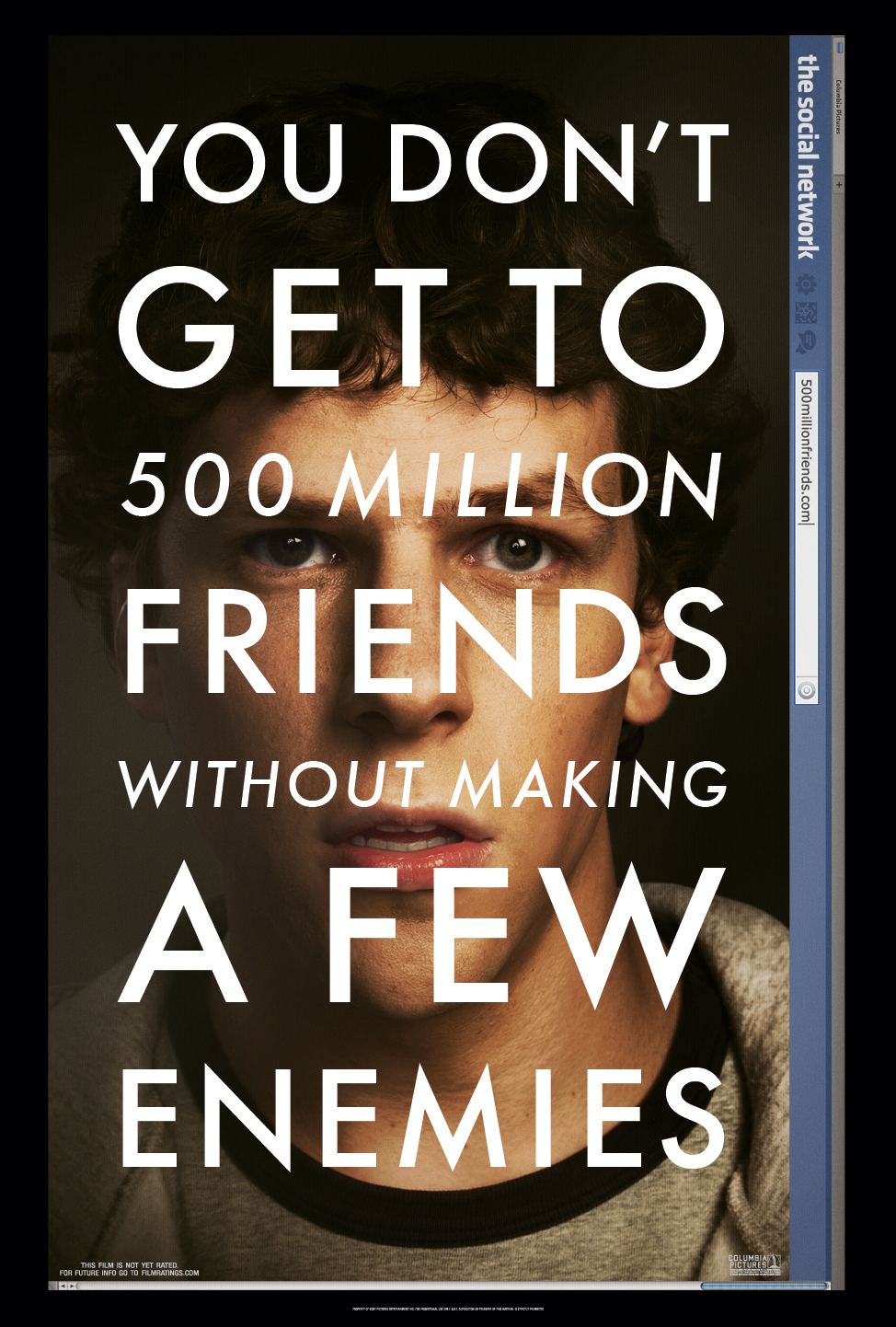 As I write this, David Fincher’s Facebook movie The Social Network edges ever closer to Oscar glory, having bagged four awards from the prestigious National Society of Film Critics in the US (a historically-strong barometer for success at the Academy Awards) and further bolstered by a great many other critical plaudits and a firm, enthusiastic presence in the higher echelons of innumerable Top Ten of 2010 lists. The vaunted critical appendage “Masterpiece” has been used, I note, with dazzling regularity. All of which, you know, is really not bad going for the most utterly overrated, frustratingly mediocre and resolutely boring film in recent memory.
I must confess to being genuinely dumbfounded by the Niagara-like waterfalls of praise that have showered Fincher’s film, which appears to me to offer little more than an adequate and ultimately not-very-effective exercise in myth-making for a major and highly-influential social phenomenon. A masterpiece? Nonsense. I am always deeply suspicious of the immediate usage of that word and, these days, I think it’s used to draw attention to the reviewer rather that the film reviewed. Real cinematic masterpieces – the obvious examples Welles’ Citizen Kane or Coppola’s The Godfather Parts I or II – were not bestowed that description until years, even decades, after their release, benefiting from considerable periods of measured critical appreciation – not six months of rapacious hyperbole.
I am a big admirer of David Fincher’s work as a director and what surprised me most about the film was just how… limited?… it all felt. Competently made, without question, but featuring none of the bravura touches or vivid atmospheres that made the likes of Fight Club, Se7en, Panic Room or The Curious Case of Benjamin Button so beguiling and enthralling. I don’t feel that the ‘talkiness’ of The Social Network was a particular hindrance on Fincher, as Zodiac was an even more dialogue-heavy film and that was nothing less than riveting. Consequently, to think of The Social Network as one of Fincher’s very best works is something of a decidedly-forced claim. Indeed, I firmly think it’s his weakest film. Which isn’t to say it was without strengths: I found much to enjoy in Aaron Sorkin’s script – the implied notion that the germ of a Facebook was a misogynistic prank was nicely dry irony – and I certainly thought that Trent Reznor and Atticus Ross’ score was a fantastic piece of work.
I think the core problem with the film is that the creation story of Facebook is actually not a very interesting or dramatically-rich tale. Essentially: a Harvard web genius with sorely-limited social skills blatantly fucks over a group of overwhelmingly-entitled Yuppie scum (fellow students) who had a similar idea, clearly using his borderline-OCD personality as a form of plausible deniability. This ultimately fails and, via inevitable and extensive litigation, he has to payout a vast sums money to said elitist wankers, which he barely notices because said website ultimately makes him into a billionaire. That’s it. It’s pretty clear cut.
A friend who, regrettably, had been the victim of blatant Intellectual Property theft himself, argued that the film was utterly emblematic of our times and he assured me that (the filmic) Zuckerberg was precisely representative of the kind of entitled charlatans who proliferate in modern Media, their incredibly high-opinion of their own “genius” providing them the (im)moral wherewithal to steal without reservation and then engage ferocious self-righteous indignation when challenged. I agree with him on the first point – and will happily take his word for it on the second – but I still maintain that it doesn’t come off as a rewarding piece of cinema.
 Perhaps it’s down to the fact that every single character in The Social Network is pretty much detestable. Jesse Eisenberg’s Zuckerberg – who, by the way, wears shorts and flip-flops in winter weather. Ergo, audience-members, he is quite clearly “QUIRKY” – is an utterly boring character, possessing no charisma or charm at all, and one imagines that, to achieve what he did, the real Zuckerberg must have had some. Armie Hammer’s Winklevoss twins and Max Minghella’s Divya Narendra were stock examples of the elitist dickheads who think they deserve wealth and power, Justin Timberlake’s Sean Parker was an irritating, duplicitous, coke-fuelled bullshit artist and Andrew Garfield’s Eduardo Saverin – a clear focal point for the audience’s sympathies – came across as a whining moron somehow shocked by the fact that money and morality don’t mix (futhermore: he sucked as a Chief Finanicial Officer. It was laughable how easily he was screwed out of his stake). I understand Sorkin’s willingness to indulge fiction – after all, the reality of Facebook’s was undoubtedly very mundane – but his characters felt sketched rather than nuanced.
That lack of nuance goes for the film as a whole, I think. Most, if not all, of Fincher’s previous films are pleasures to revist, repeatedly engaging and generating new details to notice and appreciate. The same cannot be said about The Social Network. As a piece of cinema, its timeliness does not assure its timelessness, the latter surely being a requirement of a masterpiece.
(Thanks to Black Dog Podcast associate Jim Moon for permission to use his terrifically-funny subversion of The Social Network poster. You can visit the gentleman’s website at: http://hypnogoria.blogspot.com/)
1 Comment
Spot on Danny. The most enthusiasm I could muster was that it was “s’okay” and then pop Zodiac and The Game on. A completely forgettable experience. An example of how important story is, even if everyone else working on the film is the best talent you can get. I didn’t give a shit about fb, any of the characters or what happened to them and even if I wanted to hate the Sean Austin character Timberlake’s performance was so infants school nativity play standard I didn’t even give a shit about that. Unlike.